The Most Common Guangzhou Market Scams Targeting Foreign Buyers — And How to Avoid Every One of Them
 MortyUpdated May 8, 20266 Mins read
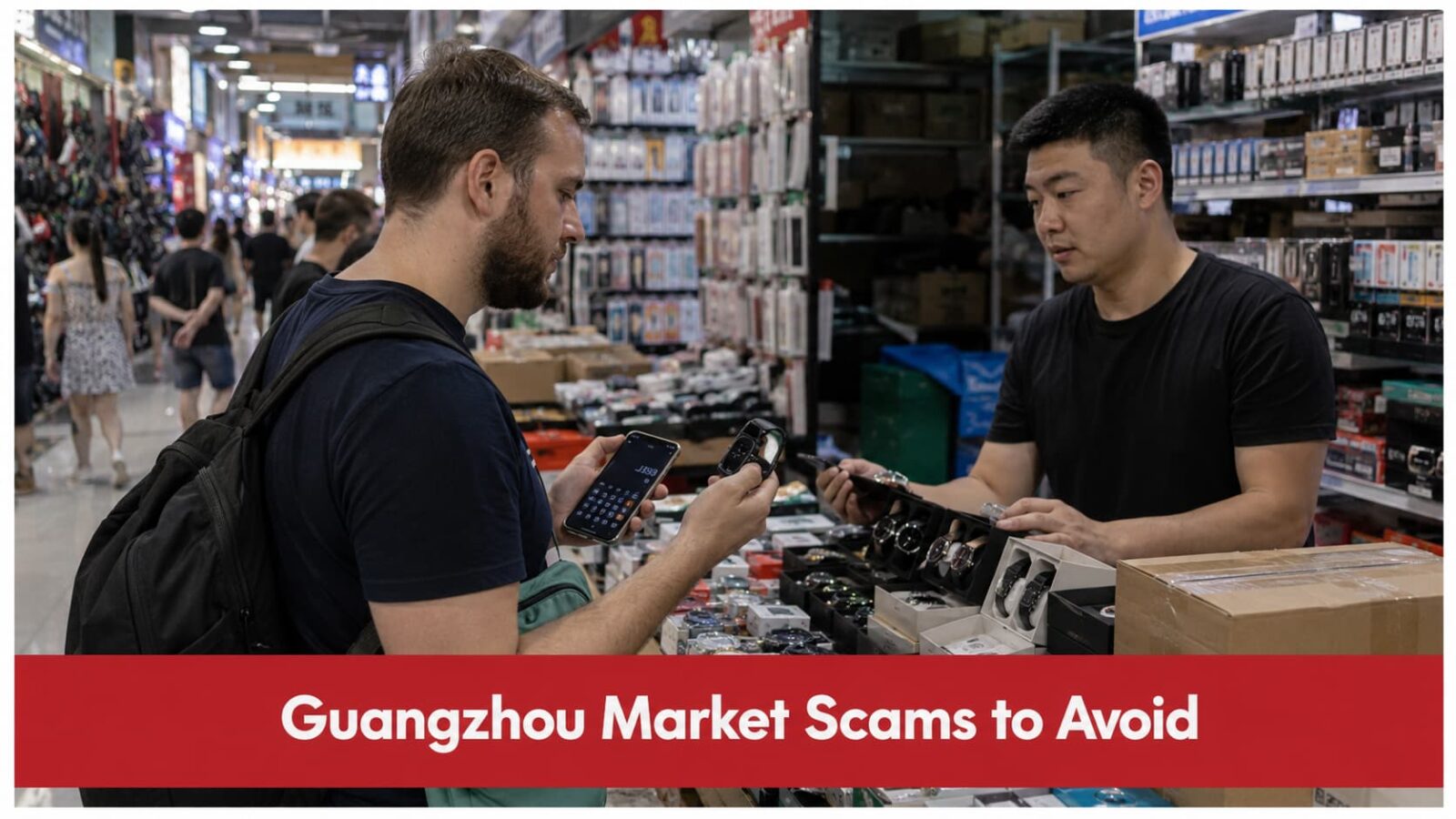
I’ve watched it happen more times than I can count. A buyer flies into Guangzhou, walks into Dashatou or Yiwu with a budget and a dream, and walks out having spent thousands on goods that never arrive, don’t match the samples, or fall apart before they clear customs. It’s not stupidity — it’s inexperience. And the people running these scams are genuinely good at what they do.
After years of living and sourcing in Guangzhou, I’ve seen every trick in the book. This guide is my attempt to put all of it in one place so you don’t have to learn the hard way.
Why Guangzhou Markets Attract Scammers
Guangzhou is the world’s manufacturing heartland. Baiyun Leather, Yide Road wholesale, the Canton Fair, Shisanhang garments — these are legitimate, world-class sourcing destinations used by businesses from every country on earth. That volume and legitimacy is also exactly what makes it attractive for bad actors.
The markets operate on information asymmetry. You don’t speak Cantonese or Mandarin. You don’t know the fair price for a container of goods. You don’t know which supplier actually made the product and which one is reselling it with a markup. Scammers thrive in that gap.
The good news: every scam has a tell. Once you know what to look for, you become a much harder target.
Scam #1: The Bait-and-Switch on Quality
This is the most common one, and it catches experienced buyers too.
Here’s how it works. You visit a stall or factory showroom, you’re shown beautiful samples — tight stitching, solid hardware, good materials. You place an order. When the goods arrive (weeks later, on the other side of the world), they’re made with cheaper materials, flimsier construction, or outright different specifications than what you agreed on.
Why it works: By the time you receive the goods, you’re in a different country, the supplier knows a dispute is expensive and slow, and your contract (if you even have one) may not specify quality standards in enough detail to win.
How to avoid it:
- Never pay 100% upfront. Use a 30% deposit / 70% before shipment structure at minimum.
- Hire a third-party inspection company (SGS, Bureau Veritas, or a local Guangzhou-based inspector) to check goods at the factory before the balance is paid. This is not optional for orders above $2,000.
- Keep every sample. Photograph it with a ruler and your business card visible. Email the photos to the supplier with a note that the production run must match exactly — this creates a paper trail.
- Specify materials in the contract by weight, grade, or composition, not just by appearance.
Scam #2: The Ghost Supplier (Middleman Posing as Factory)
You find a supplier in a market or on Alibaba. They give you a factory tour. They quote you factory-direct prices. Except they’re not a factory — they’re a trading company that outsources production to whoever is cheapest that week, which changes your quality with every order.
This isn’t always malicious, but it means you have zero quality control, volatile pricing, and no relationship with the actual manufacturer.
How to spot it:
- Ask to see the business license. A factory will have a manufacturing license (生产许可证). A trading company won’t.
- On Alibaba, look for “Manufacturer” badge vs “Trading Company” — these are self-reported but still useful.
- Ask which factory will produce your goods and whether you can visit it. A genuine factory will say yes. A middleman will deflect.
- Do a factory audit, either yourself or through an agent.
Scam #3: The Fake Invoice and Customs Fraud
Some suppliers will offer to undervalue your goods on the commercial invoice to help you pay less customs duty when you import. This sounds helpful. It is illegal in your home country and puts the liability entirely on you.
Others will issue inflated invoices at your request (for insurance or financing purposes) — again, your problem, not theirs, if customs flags it.
The rule: Always use accurate invoices. The short-term duty saving is never worth the customs seizure, penalty, or criminal liability risk.
Scam #4: The Disappearing Deposit
You meet a supplier in a market, negotiate a great price, pay a deposit via bank transfer or WeChat Pay, and they stop responding. The stall is still there — but it’s now selling different products and the owner claims no knowledge of your transaction.
This is most common in the very large wholesale markets (Shisanhang, Yide Road) where individual stalls are rented month-to-month and turnover is high.
How to avoid it:
- Never pay deposits via WeChat Pay or personal Alipay to an individual’s account. Always pay to a verified business account.
- Use Alibaba Trade Assurance for any supplier you find through that platform — your payment is held in escrow until you confirm receipt.
- For market vendors you meet in person, get a full business card with the company name in Chinese, photograph their business license on the wall of the stall, and verify the company name against the bank account you’re paying into.
- For significant orders, use a Letter of Credit (LC) through your bank. It costs more but offers real protection.
Scam #5: The Sample Fee Trap
A supplier asks for a “sample fee” of $50–$200, which they promise to refund against your first order. You pay. They send a sample. It’s fine. You negotiate further. Then they keep raising the minimum order quantity or the unit price until the deal no longer makes sense — and conveniently, that sample fee is non-refundable under their terms.
How to handle it: Sample fees are normal and legitimate. What’s not normal is a sample fee with no written terms for refund conditions. Get those terms in writing before you pay, and don’t let a sample fee create psychological pressure to place an order that doesn’t make business sense.
Scam #6: The Post-Order Price Increase
You negotiate a price, place an order, and pay the deposit. Then, partway through production — or right before shipment — the supplier contacts you to say raw material costs have gone up and the price needs to increase by 10–20%. They know you’re committed. Refusing means losing your deposit and starting over.
How to avoid it:
- Get the full unit price and total order value locked in a written purchase order, signed by both parties, before paying any deposit.
- Include a clause stating the price is fixed regardless of material cost fluctuations during the production period.
- If a supplier refuses to sign a PO, that tells you everything you need to know.
Scam #7: IP Infringement — Getting You Into Trouble
A supplier offers to make branded goods (Nike, Apple, Gucci, Supreme — whatever you want) at a fraction of the price. You buy them, ship them home, and customs seizes the container. You face fines, legal exposure, and lost goods. The supplier faces nothing.
This one catches buyers who genuinely didn’t realize what they were doing. Some markets in Guangzhou are known for counterfeit goods. Buying them for personal use is one thing legally (and still risky at customs). Importing them commercially is a serious offense in most countries.
The rule is simple: If the price seems impossible for a legitimate brand product, it’s not legitimate.
General Rules for Safer Sourcing in Guangzhou
After all of that, here’s the short version of what works:
Verify before you pay. A business license, a factory audit, and a third-party inspection are not bureaucratic formalities — they are your actual protection.
Create paper trails. Every agreement, specification, sample approval, and price confirmation should be in writing, preferably email rather than WeChat, so it’s retrievable and admissible.
Use escrow or trade assurance whenever possible. Paying directly into a personal account is the single fastest way to lose money in this market.
Build relationships over time. The buyers who get the best prices and the most consistent quality are the ones who have worked with the same supplier for years. Your first order with anyone should be small enough that you can afford to lose it.
Bring a sourcing agent you trust, or hire an inspector. A local who speaks the language, knows the market, and has no stake in the transaction is worth every yuan of their fee.
Final Thought
Guangzhou’s wholesale markets are genuinely one of the most exciting places in the world for a buyer. The variety, the prices, the access to manufacturing — it’s unlike anywhere else. But it rewards people who come prepared.
Do your homework before you arrive, get your agreements in writing, protect your payments, and inspect your goods before they ship. None of this is complicated. It just requires slowing down at the moments when a good deal is making you want to move fast.
If you’re planning your first sourcing trip to Guangzhou and want to know exactly which markets to visit for your product category, check out our Guangzhou wholesale markets guide for the full breakdown.
Have you been scammed sourcing from Guangzhou? Or do you have a tip that helped you stay protected? Drop it in the comments — this guide gets updated based on what readers share.
Guangzhou Wholesale Markets Guide (2025): Full List
Guangzhou's wholesale and specialty markets (in English and chinese) with addresses, quick...
MortySeptember 1, 2025
Made in America, Owned by China: The Surprising Truth
Explore major US companies owned by Chinese entities and the economic impact...
MortyMay 27, 2025

Cracking the Code: How to Successfully Find and Vet Companies in China
Find a reliable company in China for sourcing or partnerships. Discover strategies,...
MortyMay 26, 2025


The Engines of China: A Look at the Country’s Powerhouse Industrial Cities
Explore China's top industrial cities driving innovation, manufacturing prowess, and robust economic...
MortyApril 10, 2025

Leave a comment